
Customs Bonded Warehousing in Canada: Duty Deferral Guide | SPExpress
Canadian ecommerce brands have spent the past two years tracking a moving target: U.S. tariff actions, the end of Section 321 and de minimis treatment, and now an unresolved CUSMA Joint Review that leaves cross-border trade in an annual review cycle instead of a settled agreement. Most of that conversation focuses on what a brand owes and when. Fewer brands ask a related question that can meaningfully improve cash flow: does duty have to be paid the moment goods land in Canada at all?
For many importers, the answer is no. Canada’s customs bonded warehouse program, administered by the Canada Border Services Agency (CBSA), lets qualifying businesses store imported goods without paying duties and taxes until those goods actually enter the Canadian market. Goods that are re-exported instead can move through duty-free entirely. It is one of the least-discussed tools available to Canadian importers, and it is more relevant in 2026 than it has been in years.
This guide explains how bonded warehousing actually works, how it differs from similar-sounding programs, and when it makes sense for a growing ecommerce brand to consider it as part of a broader fulfillment and trade strategy.
Customs Bonded Warehousing in Canada: A Duty Deferral Strategy for Ecommerce Brands
What is customs-bonded warehousing?
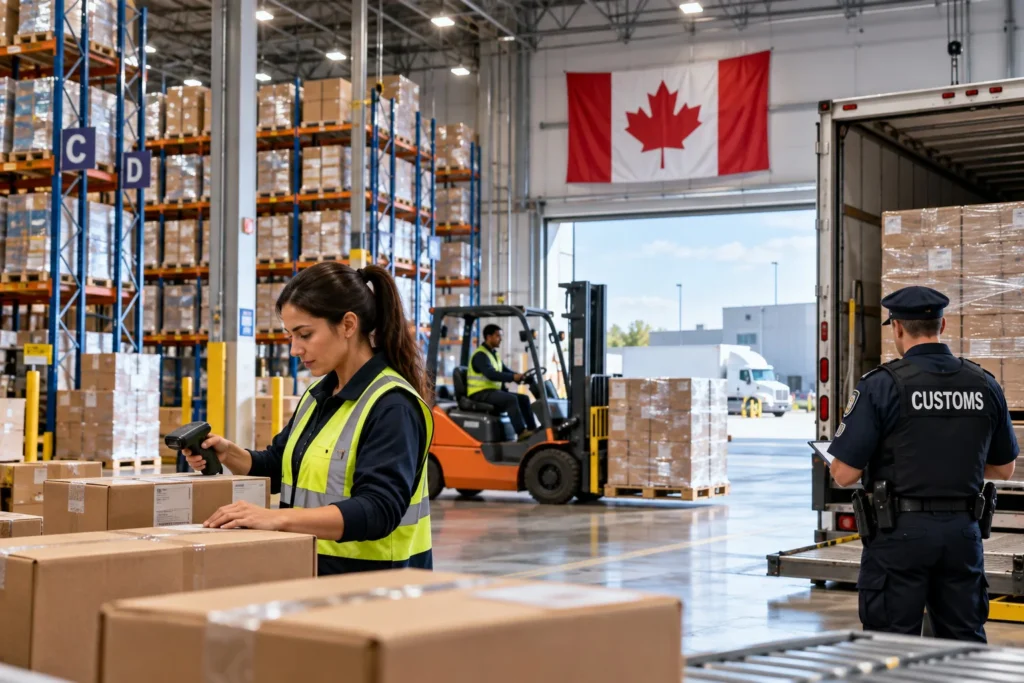
A customs bonded warehouse is a storage facility that is privately operated but licensed and regulated by the CBSA. Goods imported into Canada can be placed in a bonded warehouse without the importer paying duties, excise tax, or GST at the border. Those amounts stay deferred for as long as the goods remain in bond, and become payable only when the goods are released for sale into the Canadian market.
If the goods are instead re-exported to another country, no Canadian duty or tax is owed on them at all. That single feature is what makes bonded warehousing attractive to two very different kinds of businesses: importers who want to delay a cash outlay until a sale actually happens, and businesses using Canada as a distribution point for goods bound for other markets.
How CBSA duty deferral actually works
Operating a bonded warehouse requires a CBSA licence, applied for using Form E401 through the CBSA’s Client Portal. The application process involves a review of the proposed facility, an inspection of the physical location, and an audit of the applicant’s recordkeeping systems, since the CBSA needs confidence that goods entering and leaving bond are tracked accurately. Approved operators receive a licence number and a four-digit sublocator code that must appear on import documentation for goods moving into that facility.
Licensed operators are also required to post security, generally equal to at least 60% of the maximum duties and taxes that could be owed on the goods held in the warehouse at any given time. That security protects the CBSA in case goods are released without the correct duty being paid.
Most ecommerce brands do not apply for their own bonded warehouse licence. Instead, they work with a fulfillment partner or customs broker that already holds one, and simply use bonded storage as one option within that provider’s warehouse network.
Bonded warehouse vs. sufferance warehouse vs. Duties Relief Program
These terms get used loosely, and mixing them up leads to confusion about what a business is actually entitled to.
- Bonded warehouse. Longer-term storage, up to four years in most cases, with duty and tax deferred until goods are released into the domestic market or re-exported duty-free.
- Sufferance warehouse. A short-term holding facility used while goods clear customs, typically for a matter of days rather than years. It is a processing stop, not a duty-deferral strategy.
- Duties Relief Program. A separate CBSA program that lets approved importers bring goods into Canada without paying duty upfront at all, provided those goods are eventually exported. It serves a similar re-export goal to bonded warehousing but works through a licence held by the importer rather than storage in a bonded facility.
For most Canadian ecommerce brands, bonded warehousing is the more practical route, because it is delivered through a fulfillment partner’s existing facility and licence rather than requiring the brand to hold its own CBSA authorization.
Why duty deferral matters more during 2026 trade uncertainty
Duty deferral is not a new program, but it is getting a second look this year for a specific reason. SPExpress has already covered how the 2026 CUSMA Joint Review left cross-border trade in an ongoing annual review process rather than a settled agreement, and how U.S. tariff actions have added sector-specific duties on top of that uncertainty. Together, those developments mean duty rates on some goods are less predictable than they were a few years ago, and brands are holding more inventory as a buffer against supply disruption.
That combination is exactly where bonded warehousing earns its keep. Paying duty upfront on a large inventory buffer ties up cash on goods that have not sold yet, and if a duty rate on a specific category changes again mid-year, goods that already cleared and paid duty cannot recover the difference. Goods sitting in bond, by contrast, are released and duty-assessed only when they are actually pulled for sale, using the rate in effect at that time.
Cash flow and inventory benefits for growing ecommerce brands
Beyond trade-policy timing, bonded warehousing offers a handful of concrete operating advantages worth weighing against the added complexity:
- Preserved working capital. Duty and tax that would otherwise be paid at the border stays in the business until goods actually sell, which matters most for high-value SKUs or large seasonal purchase orders.
- Better-matched inventory release. Because goods can be held in bond for extended periods, a brand can bring in a full season’s stock at once for better freight rates, then release it for sale gradually as demand actually materializes.
- Support for multi-market distribution. A brand using a Canadian facility as a hub for orders shipping to the U.S. or other markets can store inventory in bond and only pay Canadian duty on the portion that is actually sold domestically.
- Reduced exposure to rate changes. If a duty rate on a product category shifts before inventory is released, only the goods still in bond are affected by the new rate going forward, rather than the whole shipment being locked into whatever rate applied on arrival.
None of this eliminates duty. It changes when duty is paid, and gives a growing brand more control over the timing of a cost that otherwise shows up as a fixed hit at the border, regardless of how quickly the inventory actually sells.
What happens when goods leave the bonded warehouse?
Goods can leave a bonded facility in one of two ways, and the two paths lead to very different outcomes:
- Release for domestic sale. When goods are pulled from bond to fulfill a Canadian order, the applicable duty and GST become payable at that point, based on the goods’ classification and value. This is typically handled as part of the customs release paperwork rather than as a separate step the brand has to manage manually.
- Re-export. When goods are shipped out of Canada instead of sold domestically, no Canadian duty applies. This is the option that makes bonded warehousing useful for brands running cross-border shipping operations where Canada is one stop in a wider distribution network rather than the final destination for every unit.
Goods generally cannot sit in bond indefinitely. The CBSA sets a maximum storage period, commonly up to four years, though the exact limit depends on the goods and the terms of the operator’s licence. In practice, most ecommerce inventory turns over well inside that window, so the time limit rarely becomes the binding constraint.
Is customs bonded warehousing right for your business?
Bonded warehousing is not the right fit for every brand, and it adds administrative steps that are not worth taking on for small, low-duty shipments. It tends to make the most sense when a business recognizes several of the following:
- You import high-value goods where the duty owed on a shipment is a meaningful cash outlay.
- You bring in large seasonal purchase orders well ahead of when the inventory will actually sell.
- A portion of your inventory is re-exported to the U.S. or other markets rather than sold in Canada.
- Your product categories are exposed to sector-specific tariff changes that could shift again during the year.
- You are already expanding warehouse capacity and want to evaluate every storage option available, not just square footage.
If none of those apply, standard duty-paid importing through a regular warehouse is usually simpler and perfectly adequate. Bonded storage earns its complexity when the dollar amount of deferred duty, or the re-export volume, is large enough to matter.
How SPExpress supports duty deferred fulfillment
SPExpress works with Canadian ecommerce brands on the full fulfillment picture that duty deferral sits inside of: warehousing capacity across facilities, accurate pick and pack execution once inventory is released for sale, multi-carrier shipping for both domestic and cross-border orders, streamlined returns handling, and integrations that keep inventory data accurate across every sales channel. Duty timing is only useful if the rest of the fulfillment chain, receiving, storage, order accuracy, and shipping, is already solid.
Brands evaluating bonded storage as part of a broader trade strategy typically pair it with the kind of documentation and inventory placement planning covered in SPExpress’s guide to the 2026 CUSMA Joint Review, since both address the same underlying goal: staying flexible while trade terms remain in flux.
FAQ: Customs bonded warehousing in Canada
Is a bonded warehouse the same as a regular warehouse?
No. A regular warehouse stores goods after duty and tax have already been paid at import. A bonded warehouse is a CBSA-licensed facility where imported goods can be stored with duty and tax deferred until they are released for domestic sale, or exempted entirely if the goods are re-exported.
Who can use a customs bonded warehouse in Canada?
Both Canadian residents and non-resident businesses can use bonded warehousing. Most ecommerce brands do not hold their own CBSA licence; instead, they use bonded storage space through a fulfillment partner or customs broker that already holds the licence and handles the compliance requirements.
How long can goods stay in a bonded warehouse?
Commercial goods can typically remain in bond for up to four years from the date they entered Canada, though the exact period can vary by goods type and licence terms. Most ecommerce inventory turns over well within that window.
Does a 3PL need its own bonded warehouse licence?
Yes. A fulfillment provider offering bonded storage must hold a CBSA bonded warehouse licence for that facility, post the required security, and maintain the recordkeeping the CBSA expects. Brands working with a licensed 3PL benefit from that infrastructure without needing to apply for a licence of their own.
If ongoing trade uncertainty has your business rethinking how much duty you pay upfront versus over time, contact SPExpress to talk through whether duty-deferred storage fits your inventory strategy, or explore SPExpress pricing to see how fulfillment and warehousing costs compare for your order volume.
Need a more resilient fulfillment operation? Contact SPExpress to discuss Shopify integrations, warehousing, shipping, inventory visibility, and 3PL support designed for Canadian ecommerce growth.
Read more:
Shift From In-House to Outsourced Fulfillment – When it’s Better & How to Do it Right
How Third-Party Logistics Services Can Ensure E-Commerce Growth?
The Top 6 Reasons for Outsourcing in Supply Chain Management for Your eCommerce Business
SPExpress is a trusted fulfillment partner that delivers seamless multichannel order fulfillment services to leading brands. Contact our team today to learn how we can help you optimize your hybrid fulfillment strategy.
SPExpress is committed to supporting your order fulfillment needs, regardless of the size of your online store. Our expertise and resources can help you optimize your order fulfillment strategy and achieve your business goals.
At SPExpress, we offer efficiency, scalability, and comprehensive shipping and warehousing solutions to businesses of any size, easing the burden on businesses. Get in touch with us right now to find out how our fulfillment and warehousing services may help your company. Don’t let inventory problems ruin your company; work with us to find dependable, effective solutions that give you more control. We are ready to take your order fulfillment game to new levels.
Contact us today to learn how we can assist you with your inventory management and order fulfillment strategies. Together with our experts, you can start on the path to reliable and efficient inventory management right now.