
Reduce Picking & Packing Errors | SPExpress 3PL Canada
How to Minimize Picking & Packing Mistakes in Your Warehouse
Every time a warehouse worker reaches for the wrong SKU, ships an incomplete order, or mislabels a package, a chain reaction of costs begins — costs that most e-commerce businesses dramatically underestimate. Picking and packing errors are not minor inconveniences. They are profit-draining events that trigger return shipping, customer service escalations, replacement inventory, and perhaps most damagingly, eroded customer trust that no discount code can fully repair.
For Canadian online retailers competing in an increasingly demanding marketplace, fulfillment accuracy is no longer a back-office operational detail. It is a front-line competitive differentiator that directly shapes brand reputation, customer lifetime value, and bottom-line profitability. The question is not whether your business can afford to invest in better fulfillment practices. The question is whether it can afford not to.
This article breaks down why picking and packing errors happen, what they actually cost, and how partnering with a precision-focused e-commerce 3PL Canada provider like SPExpress gives growing brands the tools, technology, and operational expertise to compete at a higher level—without taking on the overhead of building that infrastructure themselves.
How to Minimize Picking & Packing Mistakes in Your Warehouse
The True Cost of Picking and Packing Errors
To understand the true scale of this problem, consider a mid-sized e-commerce operation processing 500,000 orders per year—a volume that is entirely achievable for growing Canadian brands in categories like health and wellness, apparel, consumer electronics, or home goods. At an industry-average error rate of just 3%, that business is generating 15,000 incorrect or defective shipments annually. Each one of those errors carries a hard cost: return shipping typically runs between $8 and $15 per incident, replacement order fulfillment adds another $5 to $10, and the customer service overhead to manage the complaint, the refund, or the exchange can easily push the total cost per error to between $47 and $94. Run those numbers across 15,000 incidents, and you are looking at potential annual losses ranging from $705,000 to over $1.4 million—and that is before accounting for the long-term revenue impact of customers who simply never come back.
These figures are not hypothetical scare tactics. They reflect the operational reality that 3PL Canada professionals and logistics consultants have documented repeatedly across the warehousing industry. The challenge is that many e-commerce businesses, particularly those that handle fulfillment in-house or rely on outdated warehouse processes, lack the visibility to link individual shipping errors to their cumulative financial impact. Errors get absorbed as a cost of doing business rather than flagged as a systemic problem that demands a systemic solution.
What makes this particularly important for Canadian e-commerce businesses is the competitive pressure building in the domestic market. Consumers conditioned by major platform retailers to expect fast, accurate, and frictionless delivery do not grade smaller brands on a curve. A mispicked order is a mispicked order, regardless of whether it comes from a large-scale distribution center or a boutique brand shipping out of a leased warehouse unit. The standard has been set, and businesses that cannot reliably meet it face a structural disadvantage that no amount of great marketing can fully overcome.
Understanding how to reduce warehouse mistakes, implement pick-and-pack best practices, and build scalable fulfillment infrastructure is, therefore, one of the most important operational priorities for any serious Canadian online retailer.
Whether you are processing a few hundred orders a week or scaling toward millions annually, the principles of warehouse efficiency and fulfillment precision apply equally. The systems you put in place today, or the 3PL partner you choose to deploy those systems on your behalf, will define your fulfillment performance for years to come.
Why Picking and Packing Errors Happen
Solving any operational problem effectively requires understanding it at its root. Picking and packing errors in warehouse environments are rarely the result of careless workers or bad luck. They are almost always the predictable output of structural process failures, systemic gaps in how a warehouse is organized, how its technology is deployed, how its staff is trained, and how its operations are managed. Identifying these root causes is the first step toward building fulfillment processes that are genuinely resistant to costly mistakes.
Poor Warehouse Slotting and Product Organization
One of the most common and most underappreciated contributors to mispick prevention failures is poor warehouse slotting. Slotting refers to the strategic placement of products within a warehouse to optimize the flow of picking operations.
When products are assigned storage locations based on convenience, historical habit, or arbitrary assignment rather than data-driven logic, the warehouse creates conditions where errors flourish. Similar SKUs placed in adjacent locations, products with packaging that looks nearly identical stored in close proximity, and high-velocity items buried deep in pick paths all increase the cognitive and physical load on warehouse pickers — and cognitive load is the enemy of accuracy.
A well-slotted warehouse assigns storage locations based on pick frequency, SKU similarity risk, product dimensions, and order profile data. High-velocity items are positioned to minimize travel time. Products with similar appearances are deliberately separated. The physical layout of the warehouse actively supports accuracy rather than passively permitting errors. This is the kind of structural discipline that a data-driven operation like SPExpress fulfillment builds into its warehouse design from the ground up, rather than retrofitting after problems emerge.
Absence of Barcode Scan-Verification
Perhaps the single most impactful technology gap in error-prone warehouses is the absence of barcode scan verification at the point of pick. In operations that rely on paper-based pick lists or basic visual confirmation, the picker is the only quality control checkpoint between the shelf and the shipping box. Human visual confirmation, even with trained and motivated staff, carries an inherent error rate that no amount of supervision can eliminate at scale.
Barcode scan-verification changes this fundamentally. When every pick action requires the picker to scan both the storage location and the product barcode before the system will confirm the pick, the warehouse introduces a hard technological checkpoint that catches discrepancies in real time rather than discovering them after the order has already shipped. The error is caught at the source — before it becomes a customer complaint, a return shipment, or a replacement order.
Reliance on Manual, Paper-Based Pick Lists
Paper-based pick lists are a legacy technology that many growing e-commerce businesses continue to use long past the point where the volume of their operations makes manual processes viable. The fundamental problem with paper pick lists is that they are static; they capture order data at a moment in time and cannot reflect the dynamic reality of a live warehouse environment. Inventory movements, location changes, and order updates that happen after a pick list is printed are invisible to the picker carrying that list.
Beyond their static nature, paper pick lists create inefficient pick paths, provide no real-time feedback to warehouse supervisors, generate no data for operational analysis, and offer no scan-verification capability. They are, in essence, a system optimized for generating errors at scale. Replacing paper lists with a dynamic, screen-driven or voice-directed picking system connected to a real-time warehouse management system is one of the highest-leverage investments any warehouse operation can make — and it is precisely the kind of infrastructure that a 3PL Canada partner like SPExpress provides as a baseline operational standard rather than a premium add-on.
Inadequate Staff Training and Accountability Structures
Technology alone cannot eliminate warehouse mistakes without the human processes to support it. Inadequate staff training, particularly onboarding processes that prioritize speed over accuracy, creates a workforce that has learned to move fast but has not internalized the behavioural habits that sustain consistent quality. When new pickers are not thoroughly trained on scan-verification protocols, exception handling, and the importance of following system prompts rather than relying on memory or assumption, even the best WMS technology will be partially defeated by human workarounds.
Equally important is the accountability structure around accuracy metrics. Warehouses that do not track individual picker accuracy rates, do not conduct regular error root-cause analysis, and do not create clear feedback loops between quality outcomes and workforce behaviour are warehouses where error rates tend to remain stubbornly persistent regardless of the technology in place. SPExpress addresses this through structured operational protocols that align staff behaviour with the accuracy standards that its merchant partners depend on—making human performance and technological capability mutually reinforcing rather than working at cross-purposes.
Inventory Management Gaps and Phantom Stock
A final major contributor to picking and packing errors that deserves specific attention is the problem of inventory management gaps—particularly phantom stock, which refers to inventory that exists in the system but is not physically present in the expected location. Phantom stock typically results from receiving errors, unreported damages, theft, or the accumulation of small discrepancies that go uncorrected over time.
When a picker arrives at a location to fulfill an order and finds either an empty slot or the wrong product, the downstream consequences — substitution errors, delayed orders, and inventory inaccuracies — cascade through the entire fulfillment operation.
Preventing phantom stock requires disciplined cycle counting practices, real-time inventory tracking that updates on every movement, and receiving processes that verify incoming stock with the same rigour applied to outbound picks. These are not aspirational best practices. They are operational fundamentals that a technology-forward e-commerce 3PL Canada provider embeds into its standard fulfillment workflow, giving merchants the inventory integrity that accurate, on-time order fulfillment Canada depends on.
Pick and Pack Best Practices: Proven Strategies to Eliminate Fulfillment Errors
For any e-commerce operation serious about growth, understanding the root causes of picking and packing errors is only the first step. The real competitive edge comes from implementing pick and pack best practices that systematically prevent mistakes before they reach the customer.
Whether you operate your own warehouse or work with a 3PL Canada partner, these strategies define the difference between a fulfillment operation that scales smoothly and one that quietly bleeds revenue through avoidable errors.
1. Replace Paper Pick Lists with Barcode Scan Verification
One of the single most impactful changes any warehouse can make is eliminating paper-based pick lists. Manual pick lists are inherently error-prone; they rely on human eyes to confirm SKU numbers, quantities, and bin locations, all of which are easy to misread under the time pressure of a high-volume fulfillment environment.
Barcode scan verification forces the picker to physically scan each item before it is placed into a tote or shipping carton, and the warehouse management system (WMS) immediately validates whether the correct product has been selected. If there is a mismatch, the system flags the error in real time, before it ever becomes a customer problem.
At SPExpress, this principle is baked into every stage of the picking workflow. The proprietary WMS used at the Montreal fulfillment centre requires scan confirmation at pick, pack, and ship—creating a multi-layered verification chain that dramatically reduces the likelihood of a mispick slipping through. For merchants whose product catalogues include items with similar packaging or closely numbered SKUs, this kind of automated verification is essential.
2. Optimize Your Warehouse Slotting Strategy
Poor warehouse slotting, the physical arrangement of products within a facility, is one of the most underappreciated contributors to warehouse mistakes. When fast-moving SKUs are stored far from packing stations, or when similar-looking products are placed in adjacent bins, errors and inefficiencies multiply. A well-designed slotting strategy places your highest-velocity items in prime pick zones, reduces unnecessary travel time, and physically separates products that are commonly confused with one another.
Effective slotting is not a one-time exercise. As your product mix evolves with seasons, promotions, and new launches, your warehouse layout should be re-evaluated accordingly. SPExpress Fulfillment operations apply continuous slotting optimization supported by real-time sales velocity data drawn directly from the WMS, ensuring that the physical layout of the warehouse always reflects current demand patterns rather than how inventory happened to arrive.
3. Implement Zone, Batch, or Wave Picking and Know Which to Use
Not all picking methods are equal, and choosing the wrong one for your order profile is a reliable way to introduce both errors and inefficiencies. The three most widely used methods each serve a different purpose. Zone picking assigns pickers to specific areas of the warehouse, reducing congestion and keeping individuals expert in their designated sections. Batch picking allows a single picker to collect items for multiple orders in a single pass through the warehouse, maximizing efficiency when order volumes are high and SKU counts per order are low. Wave picking combines both approaches, coordinating pick release times to align with shipping carrier cut-offs and packing station capacity.
Selecting the right method requires a clear understanding of your order profiles, average items per order, SKU diversity, shipping urgency, and peak volume windows. SPExpress applies intelligent wave planning through its automated robotic picking system, dynamically allocating picking tasks in real time to minimize travel paths, reduce picker fatigue, and keep error rates as close to zero as operationally achievable. For e-commerce merchants who have never had visibility into these mechanics, partnering with a tech-driven 3PL is often the fastest way to gain access to these optimized methods without building the infrastructure from scratch.
4. Build a Cycle Counting Program — Not Just Annual Inventory Counts
Inventory accuracy is the foundation of fulfillment accuracy. If your WMS believes you have 200 units of a product on hand but your physical shelves hold only 140, every pick list generated from that data carries a built-in risk of failure. Annual physical inventory counts are a traditional safeguard, but they are too infrequent to catch the small, cumulative discrepancies that build up in active fulfillment environments.
Cycle counting, the practice of counting a rotating subset of your inventory on a daily or weekly basis, keeps inventory records accurate continuously rather than periodically. High-velocity SKUs should be counted most frequently, while slower-moving items can be rotated into the count schedule less often. SPExpress integrates cycle counting into its daily warehouse operations, ensuring that inventory data in the WMS reflects reality at all times. This matters enormously for merchants because overselling, stockouts, and substitution errors all trace back to inventory inaccuracy—and cycle counting is the most cost-effective antidote available.
5. Standardize Your Packing Station Process
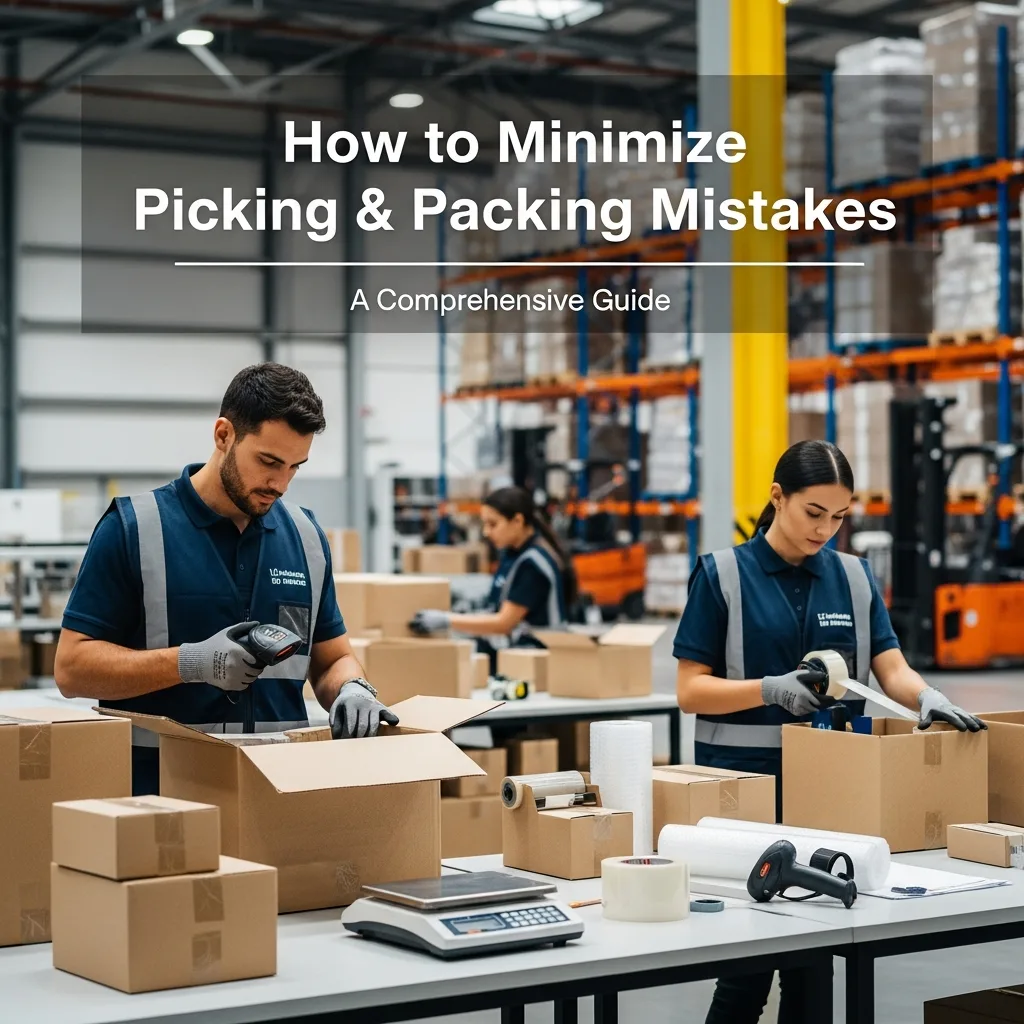
The packing station is where fulfillment errors that survived the pick stage either get caught or get shipped. A well-designed packing process includes a final scan verification of all items before boxing, a weight or dimension check to confirm the expected contents are present, standardized carton selection logic to minimize dimensional weight charges, and a clear escalation path for exceptions. Packing stations should be organized ergonomically, with all materials, like void fill, tape, labels, and poly bags—within arm’s reach to prevent the hurried shortcuts that introduce errors during peak periods.
When you outsource fulfillment to SPExpress, these standards are already embedded in the operation. Merchants benefit from a packing workflow that has been refined across hundreds of thousands of orders, rather than developing it through costly trial and error at their own expense. The result is a consistent, auditable packing process that supports both warehouse efficiency and a better unboxing experience for the end customer.
Fulfillment Accuracy Is a Growth Strategy
Every e-commerce business reaches a point where the limits of its fulfillment operation become the limits of its growth. Orders that ship wrong, inventory that doesn’t match the system, packing stations overwhelmed during peak periods, and carrier cut-offs missed because of slow manual processes—these are not signs of bad luck. They are signs of a fulfillment infrastructure that has reached its capacity and needs to be replaced with something more capable. Picking and packing errors are not inevitable. They are the predictable output of systems and processes that were never designed for precision at scale.
Throughout this article, we have examined the full landscape of fulfillment accuracy: why the cost of warehouse mistakes is far greater than most merchants realize, what technology makes possible when it is properly integrated into a fulfillment operation, which pick and pack best practices have the most impact on error reduction, and how the Canadian e-commerce market’s rising expectations make precision fulfillment a competitive necessity rather than a luxury.
The throughline in every section is the same: accuracy requires systems, not just effort. Good intentions and hardworking staff are not sufficient when the underlying processes are manual, fragmented, or poorly designed. What drives fulfillment accuracy is the combination of scan verification, optimized picking methodologies, real-time inventory management, and a warehouse management system that catches errors before they ship not after.
SPExpress was built around this understanding from the ground up. The Montreal fulfillment center combines a proprietary smart WMS with an automated robotic picking system specifically to address the root causes of fulfillment errors at the process level rather than the human level. This is a meaningful distinction. Operations that rely on training and supervision to maintain accuracy are always vulnerable to the variability that comes with staffing changes, peak season pressures, and the natural limits of human attention. Operations that rely on technology to enforce accuracy, through mandatory scan verification, algorithmic pick-path optimization, and real-time inventory reconciliation, maintain consistent performance regardless of order volume or operational conditions.
For Canadian online retailers evaluating their fulfillment options, SPExpress represents a partnership model that delivers enterprise-grade warehouse efficiency and accuracy without the capital investment of building it internally. Merchants retain full visibility through a real-time inventory dashboard, gain access to competitive carrier rates that reflect the collective shipping volume of a 3PL Canada operation, and benefit from a fulfillment process that is continuously optimized rather than periodically reviewed. The cost of errors — in reshipping, customer service, and brand trust — goes down. The capacity to scale confidently goes up.
Take the Next Step Toward Error-Free Fulfillment
If your current fulfillment operation is generating customer complaints about wrong items, struggling with inventory discrepancies, or simply consuming more management attention than it should, the answer is not to hire more warehouse staff or implement stricter manual checking procedures. The answer is to transition to a fulfillment model designed from the ground up to prevent the errors you are currently spending time and money correcting.
SPExpress works with e-commerce businesses across Canada—from emerging DTC brands to established multichannel retailers—to deliver the pick and pack best practices, technological infrastructure, and operational precision that modern order fulfillment in Canada demands.
Whether you are currently fulfilling orders in-house and feeling the strain, or working with a 3PL that is not meeting your accuracy standards, SPExpress offers a demonstrably better model. The combination of robotic picking automation, a proprietary WMS, scan verification at every workflow stage, and continuous inventory accuracy programs means that reducing warehouse mistakes is not a goal at SPExpress— it is the operational default.
Connect with the SPExpress team today to discuss your current fulfillment challenges, review your order volumes and SKU profile, and explore how a transition to precision-focused 3PL Canada fulfillment could transform your customer experience, reduce your operational costs, and give your e-commerce business the logistics foundation it needs to grow with confidence.
Read more:
Shift From In-House to Outsourced Fulfillment – When it’s Better & How to Do it Right
How Third-Party Logistics Services Can Ensure E-Commerce Growth?
The Top 6 Reasons for Outsourcing in Supply Chain Management for Your eCommerce Business
SPExpress is a trusted fulfillment partner that delivers seamless multichannel order fulfillment services to leading brands. Contact our team today to learn how we can help you optimize your hybrid fulfillment strategy.
SPExpress is committed to supporting your order fulfillment needs, regardless of the size of your online store. Our expertise and resources can help you optimize your order fulfillment strategy and achieve your business goals.
At SPExpress, we offer efficiency, scalability, and comprehensive shipping and warehousing solutions to businesses of any size, easing the burden on businesses. Get in touch with us right now to find out how our fulfillment and warehousing services may help your company. Don’t let inventory problems ruin your company; work with us to find dependable, effective solutions that give you more control. We are ready to take your order fulfillment game to new levels.
Contact us today to learn how we can assist you with your inventory management and order fulfillment strategies. Together with our experts, you can start on the path to reliable and efficient inventory management right now.