
Most ecommerce fulfillment advice is written for small parcels: a T-shirt, a skincare bottle, a phone case. But a growing number of Canadian brands sell furniture, fitness equipment, appliances, outdoor gear, mattresses, or other large and heavy products, and for them, standard parcel-shipping advice does not hold up. A single oversized item can trigger surcharges worth more than the product’s entire margin if the fulfillment setup is not built for it.
This guide explains what counts as an oversized or bulky item in Canadian shipping, why these products break standard fulfillment assumptions, and how to structure warehousing, packaging, and carrier strategy so large items stay profitable instead of quietly eating into revenue.
What counts as an “oversized” or bulky item in ecommerce shipping
Every major carrier sets its own thresholds, but the general pattern is consistent: once a package exceeds a certain actual weight, a certain dimensional weight, or a certain single-side length, it moves out of standard parcel pricing and into a special-handling or freight category. Canadian carriers use several overlapping labels for this: additional handling, oversized, residential heavyweight, large package, and over-maximum-limit are all common tiers, each with its own surcharge.
Purolator, for example, applies separate peak-period fees for additional handling and oversized items, a higher fee for large packages, and a much steeper fee for anything over the carrier’s maximum size or weight limit. Canada Post applies its own oversized surcharge to parcels that exceed its size and weight specifications, and DHL Express calculates demand surcharges by weight during high-volume periods. The exact dollar figures change with each carrier’s rate update, which is exactly why brands selling large products need to build shipping strategy around categories and thresholds, not a single quoted rate.
Shipping Bulky and Oversized Items in Canada: A Fulfillment Guide for Growing Ecommerce Brands
Why Shipping Bulky and Oversized Items break standard parcel fulfillment
Carrier surcharges and freight class
Large item shipping can run several times more per pound than standard parcel service once residential delivery fees, additional-handling charges, and any liftgate or appointment-delivery requirements are added on top of the base rate. If a brand only budgets for the base freight or parcel rate and not the accessorial fees layered on top, margin can disappear quietly, one oversized order at a time. SPExpress has covered the base-rate side of this problem in its guide to dimensional weight and how to calculate it, which is the starting point for understanding why a light but bulky item can cost as much to ship as a small, dense one.
Warehouse and racking limitations
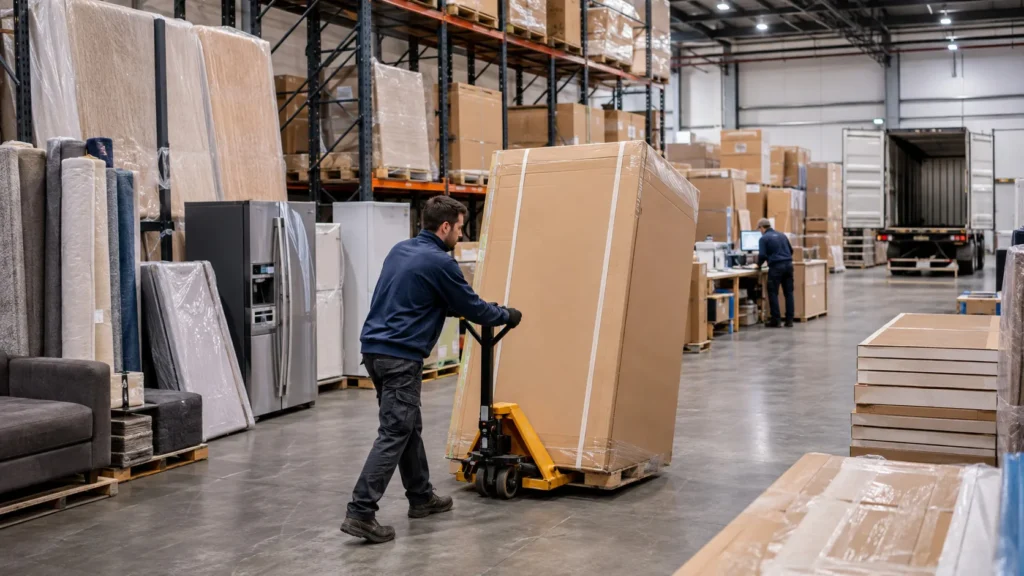
Standard fulfillment centers are built around bin shelving and light-duty racking designed for parcel-sized inventory. Large or heavy SKUs need pallet positions, floor-loaded storage, or heavy-duty racking rated for hundreds of kilograms, plus equipment like pallet jacks or forklifts to move them safely. A warehouse that is not set up for this creates real safety and damage risk, not just an inconvenience.
Packaging and damage risk
Large items are handled more times, by more people and more equipment, between the warehouse and the customer’s door than a small parcel. Corners get bumped, boxes get dropped from higher surfaces, and single-wall cartons that work fine for light products often fail under the stress of freight handling. SPExpress’s article on the most common packing mistakes businesses make covers several issues that become far more expensive once the product inside is large, heavy, and hard to replace quickly.
Parcel vs. freight: choosing the right shipping method
Not every large item needs to move as freight, and not every freight-eligible item should stay on a parcel network just because it technically still fits. The decision usually comes down to three factors: whether the item exceeds a carrier’s parcel weight or dimension limit, whether the destination can realistically receive an LTL (less-than-truckload) delivery, and whether the cost difference between parcel surcharges and freight rates favours one method over the other for that specific product.
As a general rule, products that are heavy but compact (a countertop appliance, for example) often stay cheaper on parcel networks even with an oversized surcharge attached. Products that are large in volume relative to their weight (flat-pack furniture, exercise equipment, mattresses) tend to cross into freight pricing sooner, because dimensional weight rules penalize bulk more than actual weight does.
How to control the cost of shipping large items
Brands that sell bulky products profitably tend to apply the same handful of disciplines, regardless of category.
- Right-size the packaging: reducing box volume and using denser, better-fitted protective material can shift a shipment into a lower freight class or below an oversized threshold entirely.
- Consolidate outbound freight: combining multiple large orders onto a single pallet or truck run captures volume pricing that is not available to single-item shipments.
- Match the service level to the product: not every large item needs white-glove delivery or an appointment window; matching the service to what the product and customer actually require avoids paying for service no one asked for.
- Store inventory closer to demand: for large items, the cost difference between a well-placed warehouse and a poorly placed one is magnified, because every extra zone a heavy shipment travels compounds the freight cost.
- Budget for peak season separately: oversized and additional-handling surcharges are applied on top of already-elevated peak season base rates, so a large-item shipping budget built on off-season pricing will run short in November and December. SPExpress’s guide to reducing peak season shipping costs is a useful companion resource here.
What to look for in a 3PL for bulky and oversized fulfillment
Not every fulfillment provider is equipped for large items, and choosing one that is not can be more expensive than staying in-house. Before committing, ask a potential partner about heavy-duty racking capacity, pallet and floor storage availability, equipment for moving large SKUs safely, established relationships with LTL and freight carriers (not just parcel carriers), and experience serializing and tracking large-item inventory in their warehouse management system. SPExpress’s broader guide on how to find the right 3PL for your business covers the general evaluation process this builds on.
How SPExpress supports large and oversized item fulfillment
SPExpress operates fulfillment centers in Canada with pallet and shelf storage built for a range of product sizes, along with a City Freight service designed specifically for single large-sized shipments in the roughly 20 to 100 KG range, priced by initial and additional weight rather than forced onto standard parcel rates. That structure exists because bulky products need a shipping path that reflects their actual handling requirements, not a parcel rate with an oversized fee bolted on as an afterthought.
If your business ships furniture, equipment, appliances, or other large products and is outgrowing a self-managed shipping setup, review SPExpress’s warehousing services, shipping options, and pricing page, or contact SPExpress to discuss a fulfillment setup built for bulky inventory.
FAQ: Oversized item fulfillment in Canada
What is considered an oversized package by Canadian carriers?
It depends on the carrier, but most Canadian carriers apply oversized or additional-handling fees once a package crosses specific weight, dimensional weight, or single-side length thresholds. Carriers publish these thresholds in their rate guides, and they can change with each rate update, so it is worth checking current limits rather than relying on last year’s figures.
Is it cheaper to ship large items via freight or parcel carriers?
It depends on the specific dimensions and weight. Heavy but compact items often stay cheaper on parcel networks even with a surcharge, while bulky, low-density items usually become cheaper to ship as freight once the parcel oversized fees are factored in. Comparing both options for each product category is the only reliable way to know.
Can a 3PL handle both small parcels and bulky freight?
Yes, provided the 3PL has the racking, equipment, and carrier relationships for both categories. Brands with a mixed catalogue of small and large products should confirm this explicitly before signing on, since some fulfillment centers are only equipped for one or the other.
Bulky and oversized products can be just as profitable to sell online as small ones, but only when the fulfillment setup accounts for how differently they move through a warehouse and a carrier network. Getting packaging, storage, and carrier strategy right for large items protects margin on exactly the products that are hardest and most expensive to replace or return.
Selling large or bulky products in Canada? Contact SPExpress to discuss warehousing, freight, and fulfillment support built for oversized inventory.
Read more:
Shift From In-House to Outsourced Fulfillment – When it’s Better & How to Do it Right
How Third-Party Logistics Services Can Ensure E-Commerce Growth?
The Top 6 Reasons for Outsourcing in Supply Chain Management for Your eCommerce Business
SPExpress is a trusted fulfillment partner that delivers seamless multichannel order fulfillment services to leading brands. Contact our team today to learn how we can help you optimize your hybrid fulfillment strategy.
SPExpress is committed to supporting your order fulfillment needs, regardless of the size of your online store. Our expertise and resources can help you optimize your order fulfillment strategy and achieve your business goals.
At SPExpress, we offer efficiency, scalability, and comprehensive shipping and warehousing solutions to businesses of any size, easing the burden on businesses. Get in touch with us right now to find out how our fulfillment and warehousing services may help your company. Don’t let inventory problems ruin your company; work with us to find dependable, effective solutions that give you more control. We are ready to take your order fulfillment game to new levels.
Contact us today to learn how we can assist you with your inventory management and order fulfillment strategies. Together with our experts, you can start on the path to reliable and efficient inventory management right now.